The post The Federal Motor Carrier Safety Administration Drug & Alcohol Clearinghouse – What you need to know appeared first on Solera.
]]>The FMCSA Drug & Alcohol Clearinghouse is a secure online database that gives employers, FMCSA, State Driver Licensing Agencies (SDLAs), and State law enforcement personnel real-time information about CDLs and commercial learner’s permit (CLP) holders’ drug and alcohol program violations.
The FMCSA Clearinghouse contains records of violations of drug and alcohol prohibitions in 49 CFR Part 382, Subpart B, including positive drug or alcohol test results and test refusals. When a driver completes the return-to-duty (RTD) process and follow-up testing plan, this information is also recorded in the Clearinghouse.
It is the responsibility of employers to query the FMCSA Drug & Alcohol Clearinghouse database. To help make this process easier, we’ve launched a new solution to help automate the query process. Supervision’s Clearinghouse Monitoring service is integrated with our Continuous License Monitoring program and works with your existing active driver roster. Clearinghouse Monitoring automatically queries the FMCSA Drug and Alcohol Clearinghouse database and reports any drivers with activity. You can customize your schedule to receive alerts daily, weekly, monthly, or quarterly.
Learn how Clearinghouse Monitoring can provide peace of mind and an added layer of protection for your fleet.
The post The Federal Motor Carrier Safety Administration Drug & Alcohol Clearinghouse – What you need to know appeared first on Solera.
]]>The post How car dealerships win back lost customers appeared first on Solera.
]]>These statistics emphasize how repeat business can improve your dealership’s profitability and operations. However, customers who defect can be tough to win back. To help you with this difficult but worthy task, here are some proven tips you can use to win back lost customers to your dealership.
Why customers leave dealerships
When customers stop doing business with your dealership, their exit increases your business’s attrition rate. This metric is the number of customers lost by the end of the quarter divided by the total number of customers you had at the start of the quarter.
The three main reasons why customers leave dealerships are:
Frequently, dissatisfied customers are very problematic because they rarely address their problematic customer experience directly with their dealer. But they will likely talk about their bad dealership customer experience with 9 to 15 other people. Plus, this negative word-of-mouth has the potential to spread through social media and business review websites like Yelp.
How to win them back
Fortunately, most unhappy customers leave because of solvable problems. Considering this fact, you can use these tips to get a second chance to make these defectors loyal customers again.
Lure customers back with incentives
One of the most effective methods of getting repeat business is offering incentives. Since your inactive customers are already familiar with your dealership’s services and products, an enticing discount may be all you need to get them to return.
With the help of automotive CRM software, you can send personalized texts or emails to a specific group of inactive customers. A dealer CRM and marketing software makes this action possible by allowing you to divide your customer base into segments. For example, you could offer a warranty extension to a group of inactive clients with mature or expired warranties.
Advanced marketing services allow you to target owners of your OEM vehicles who’ve received service at an aftermarket location in the last six to 12 months. It also helps you locate inactive customers by searching customer activity in the service center database.
Streamline operations
Your dealership’s efforts to win back customers shouldn’t end when they show up for service. Since the advent of online car buying and selling, most customers have elevated customer service expectations that demand the best in your dealership operations and systems. Automating processes can increase your remarketing conversion rate by optimizing your dealership performance CRM.
If your auto dealer CRM is properly optimized, you can track and respond to customer activity anytime or anywhere. It also allows you to:
- Do follow-up alerts
- Provide regular inventory updates concerning price, accessories, optional equipment, and other items.
- Efficiently manage test drive activities by updating the fleet of cars
- Collect digital signatures
- Provide a live dealership customer interaction center to communicate quickly and conveniently with customers
This technology allows you to use omnichannel communications to engage with customers at any point in the service or sale cycle. As a result, you can quickly address any customer concerns along the way.
Focus on the premium defectors
In remarketing, premium defectors are your dealership’s highest-grossing customers over the last two or three years. Identify this customer segment by monitoring long-term repurchase activities and finding the biggest spenders in your customer database.
You can then target premium defectors in your remarketing campaign for special service deals, loyalty rewards programs, service reminders, and other personalized email and social media messages.
Offer time and money-saving benefits
Saving customers time and money never go out of style as an enticement to get repeat business. And in today’s customer-centric business environment, they can be deal makers or breakers. By requiring customers to set up a service appointment by phone or a personal visit, you could be opening a door for your competition.
Use your dealership CRM software to let your customers schedule appointments from anywhere. You can also offer other advantages like:
- Providing alternative transportation in advance
- Offering a vehicle pick-up and return service
- Presenting a complimentary vehicle inspection report
Making your customer remarketing plan work
These practical tips can help you lower your dealership’s attrition rate and reclaim more inactive customers. However, it is critical that you track, report, and review your sales and service metrics. By accessing your dealership’s real-time analytics, dealership performance CRM software makes this task much more manageable. And by retargeting your past and current customers using advanced marketing, you can share promotions and incentives through display and social media ads when they are ready to service their vehicles.
Learn the benefits of our car dealership CRM software and Marketing solutions at Solera and how using this two-pronged approach can help your dealership maximize both sales and retention.
The post How car dealerships win back lost customers appeared first on Solera.
]]>The post Remove liability blind spots: Reduce driver-related risk with continuous license monitoring, analytics, and training appeared first on Solera.
]]>Drivers are the largest source of liability risk for fleets. On average, commercial fleets report a 20% crash rate per year. Accident and out-of-service costs continue to represent one of the largest fleet expenses, with motor vehicle accidents costing employers more than $56 billion and out-of-service costs for fleets going as high as $760 per vehicle per day.
It gets worse. The size of legal awards for on-the-job motor vehicle accidents is also soaring. In 2019, the average liability verdict award was $17.5 million, and the highest jury verdict for that year was a record-setting $280 million. And while some of these cases involved a wrongful death charge, more of them were due to negligence.
Negligence – or negligent entrustment liability – occurs when a dangerous article such as a vehicle is entrusted to somebody who is reckless, inexperienced, or incompetent. If the entrusted individual has an accident, the injured party has the right to bring a case against the individual’s employer. All the plaintiff needs to show to find fault with the employer is:
- The organization entrusted the vehicle to the driver
- The driver was reckless, incompetent, or unlicensed
- The organization knew – or should have known – that the driver was reckless, incompetent, or unlicensed
So how does this occur? According to Solera’s Adam Danielson and Josh Lax in our recent webinar, “The Risk of Overlooking Driver Safety,” most often it’s because the fleet only protects their own liability with the bare minimum, “good enough” approach mandated by our regulators: They pull motor vehicle reports (MVRs) once a year.
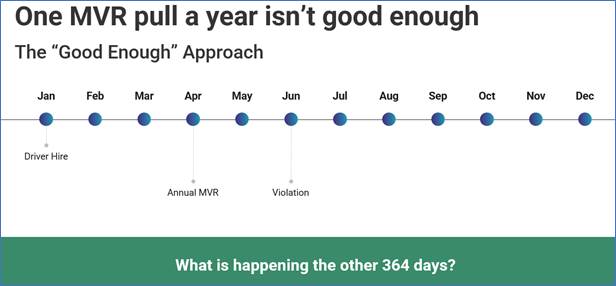
The problem with that approach is that it opens an extremely wide liability risk exposure gap of up to 364 days. If a driver receives a violation or suspension the day after the company pulls the MVR, they have a 364-day grace period before the infraction is discovered. That 364 days represents a lot of driving hours, and plenty of opportunities for that driver to have a traffic stop or be involved in an accident where the fleet could be liable.
Thankfully how to close the gap on this particular issue is fairly simple: comprehensive continuous license monitoring. With the right continuous license monitoring solution, not only can a fleet manager understand the level of risk a particular driver poses to their organization at hiring, but throughout the driver’s employment.
When a new violation or license suspension occurs for a driver, a new MVR is automatically delivered to the manager. The manager can then take immediate corrective action with the driver, thereby closing this liability exposure gap.
However, a continuous license monitoring solution is not enough to fully remove all driver-related liability blind spots. A comprehensive safety culture is required for maximum risk reduction. It’s important that you create and solidify this safety culture around your drivers.
Today’s technology makes this relatively simple. The right solution offers features that make your life and your drivers’ lives easier. For example, features like digital recordkeeping and automated hazmat compliance streamline administrative tasks. A full-service safety suite can help you identify, train, and mitigate risky drivers. Add on a driver performance and retention module to identify, reward, and retain profitable drivers.
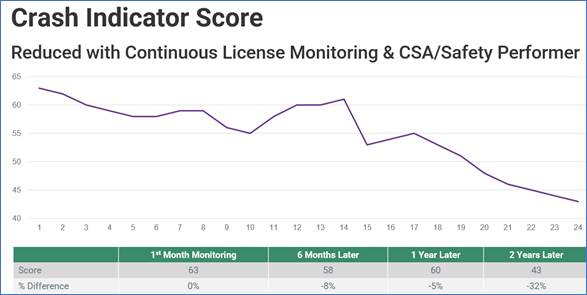
Don’t let 20% of your drivers cause 80% of your liability risk. Solera Fleet Solutions offers all these features and more with SuperVision, our comprehensive continuous license monitoring solution for fleets across the U.S. and Canada. If you want to hear more from Adam and Josh about how SuperVision can help your fleet mitigate risk and create a comprehensive safety culture, you can sign up to view their webinar on demand. For more information about SuperVision please contact us here or speak with your sales representative.
Our next webinar in the series takes place on November 16 and goes into detail about how to establish and maintain a crash-free culture. Register now to reserve your spot.
We hope to see you there!
The post Remove liability blind spots: Reduce driver-related risk with continuous license monitoring, analytics, and training appeared first on Solera.
]]>The post Separate myth from fact: Compliance and ELD mandates made crystal clear appeared first on Solera.
]]>To get the answers to these questions and more, compliance experts Kerri Wirachowsky, director, CVSA roadside inspection program, and Florence Dougherty, director of product management at Omnitracs sat down for this recent webinar. Kerri and Flo went into detail on some of your most burning questions, a few of which we’ve included below.
Does a failure to transfer a RODS citation result in a CSA score impact?
No. The confusion here comes from when the FMCSA did indicate earlier this year they were going to start adding CSA points to the 394-25D citation for failure to transfer. However, they rescinded that decision only three to four weeks later without indicating an end date.
Furthermore, anyone cited during that timeframe should not see points assessed for that specific violation.
While it is likely that the FMCSA will implement such a program in the future, there currently is no CSA score impact for such a violation.
Is the Canadian ELD mandate going to be enforced anytime soon?
Yes. The mandate itself went into effect June 12, 2021—but enforcement was delayed to Jan. 1, 2023. It will most likely not be delayed again. However, in Canada, enforcement is not quite as simple as it is in the U.S., where the FMCSA can dictate enforcement across the entire country at once.
For Canada, Jan. 1, 2023, is the official enforcement data as far as Transport Canada and CCMTA are concerned, but every province also must independently adopt and adhere to that date. Regardless, your safest bet is to assume that Jan. 1, 2023, is the enforcement start date across the board.
Now, if you don’t have a certified Canadian ELD by the enforcement date you will not be placed out of service. Transport Canada doesn’t have that authority. You will, however, be subject to fines if your ELD is not Canadian-certified.
Wasn’t the ELD supposed to solve falsification of RODS?
While falsification of logs is a top violation in the United States right now, that doesn’t necessarily indicate that specific violation is on the rise. It’s much easier for inspectors to find falsifications at roadside with an ELD than with paper logs because there’s not a lot the driver can hide. So, while the number of falsification violations seems to be increasing, it’s actually the same – but with more drivers getting caught.
Can I use an electronic logbook instead of paper logs if my ELD is malfunctioning?
Yes, but only if it meets certain requirements. All the documents indicated in sections 390 to 399 can be electronic in nature except for the shipping paper for hazardous materials. The CVSA actually has an inspection bulletin on its website that provides further guidance on which documents are eligible.
The stipulation is that if the logbook is electronic in nature but not an ELD or an AOBRD, then the driver must be able to either sign that document electronically or print that document and then sign it. Currently, if you are unable to sign your logs physically or electronically you are considered out of service for no log. The FMCSA hopes to change that from an out-of-service condition to a regular citation by April 2023.
If you want to hear Kerri and Flo answer even more important questions and see how Solera Fleet Solutions can help your fleet be effortlessly compliant, sign up to view this webinar on-demand.
The post Separate myth from fact: Compliance and ELD mandates made crystal clear appeared first on Solera.
]]>The post Why a certified ELD provider matters appeared first on Solera.
]]>ELDs provide truck dispatchers with the real-time information they need to monitor and assist their drivers while providing safer work environments for drivers. These devices make it simple to accurately manage and track record of duty status (RODS) data while seamlessly sharing it with regulatory authorities, company management, and dispatchers. As a result, these devices provide a safer means by which to track and monitor driver activity.
Canada recently adopted an ELD mandate requiring electronic data collection of semi-truck drivers’ hours of service (HOS) that takes effect on January 1, 2023. It’s similar to the mandate passed in the United States in 2017.
ELD Certified Providers Offer Access to Useful & Correct Data
Manual logbooks were prone to user error, as drivers were 100% responsible for keeping track of their resting, working, and driving hours. Replacing logbooks with ELDs provide trucking operations with standardized processes that help prevent logbook tampering and errors.
Recent ELD mandates in the US and Canada require all trucking operations, with limited exceptions, to replace logbooks and outdated electronic recording devices with third-party compliant ELD devices that connect to the truck engine’s electronic control module (ECM). These mandates exist to help keep tired drivers off the roadways by tracking and enforcing hours of operation.
Omnitracs ELD devices provide key players in the transportation timeline with access to crucial information in real-time, including:
- Driver duty status: All duty statuses indicated in HOS regulations, plus special conditions including off-duty personal conveyance and on-duty yard move, neither of which count against allotted drive time.
- Driver alerts: Omnitracs ELD devices automatically alert drivers to device malfunctions and provide a warning indicating new unassigned driving time prompts upon logging into the device.
- Key data: Devices record key data elements at predetermined intervals, including location information, vehicle distance, identification information, engine power cycles, engine hours/odometer, date, and time.
ELD Certified Providers Are Safer
With hundreds of ELD devices in the marketplace, evaluating the options can seem overwhelming. ELD-certified providers offer access to devices that are third-party certified by transportation experts in Canada and either self-certified or third-party certified in the USA.
These devices help ensure compliance with federal regulations and HOS rules designed to increase safety for truck drivers and citizens who share the road throughout the supply chain. They can help to reduce fatigue by limiting the number of hours a semi-truck driver may be behind the wheel.
ELDs that comply with US and Canadian regulations meet strict performance and design standards and are registered with the appropriate agencies.
ELD-certified providers offer increased safety for drivers and the organizations employing drivers by helping drivers comply with HOS regulations that limit the number of consecutive hours they can drive. These devices automatically record mileage providing real-time reports.
ELD Certified Providers Are Reliable
While the US ELD mandate allows ELD providers to self-certify their devices, Transport Canada requires that all approved ELD devices be certified by an accredited third party.
ELD-certified providers work hard to remain in compliance with US and Canadian standards set forth by government regulations and informed by industry experts.
ELD users spend less time on the maintenance tasks required to remain in compliance with federal regulations, including fuel tax reporting. ELDs help prevent violations that could cost your trucking operation thousands of dollars. Proactive alerts and reliable HOS countdown clocks allow users to reap the benefits of advanced technology and AI. Plus, ELDs help level the playing field by providing a tamper-proof record of driver activity.
What To Look For When Choosing An ELD-Certified Provider
Upgrading your ELDs can provide better reporting, upgraded customer support, and access to real-time data to help you make key decisions about the future of your trucking operation. Here’s how the right ELD can help support your company:
Compliance: Your ELD devices must comply with federal regulations or your organization may face hefty fines.
Feature set: Each trucking operation has unique needs. Look for a provider with features that reach beyond compliance requirements. Omnitracs ELD devices can monitor idle time to help overall increase fuel efficiency. Each hour of idle time consumes nearly one gallon of diesel fuel.
Professional installation: Omnitracs ELD device installation is performed by trained and certified technicians at your place of business.
Reporting: ELD devices equipped with advanced AI technology have the ability to provide large volumes of useful data. While this data may seem overwhelming, it can provide crucial information to help guide your business. Used correctly, data from ELD devices can help increase efficiency and productivity.
Omnitracs ELD Devices Meet US FMCSA and Canadian ELD Mandates
Omnitracs provides trucking companies, owner-operators, and dispatchers with access to several registered ELD devices on the U.S. Federal Motor Carrier Safety Administration’s (FMCSA) list of approved devices. The Omnitracs Intelligent Vehicle Gateway ELD received third-party certification in Canada in 2022, and the XRS Relay is also certified in Canada.
Canadian trucking companies will face full enforcement of the ELD mandate as of January 1, 2023. This comes after Transport Canada’s June 2022 amendment to the Commercial Vehicle Drivers’ Hours of Service (HOS) regulations.
Solera builds data while leveraging cutting-edge technology to support customer experiences. Contact us today to learn more about how our technology helps create safer working environments for truck drivers while supporting North American trucking operations as they seek to remain in compliance with ELD mandates in the U.S. and Canada.
The post Why a certified ELD provider matters appeared first on Solera.
]]>The post How delivery routing software elevates your fleet management team appeared first on Solera.
]]>While you may already know that delivery routing and dispatch software are superior to manual route planning, you may not know that this logistics technology has benefits beyond just handling additional orders or cancellations.
What Is Delivery Routing Software?
Delivery routing software is a collection of algorithmic tools designed to optimize the process of fulfilling a target number of orders per day. To carry out the primary purpose, route optimization monitors fuel costs, maintenance costs, driver activity, delivery delays, traffic conditions, and route characteristics.
Essentially, delivery routing software gives you a dynamic routing solution with automated tools to replace the standard routing system comprised of labor-intensive human requirements, like filling out a routing table by hand.
Understanding How Delivery Routing Software Works
Delivery routing software helps you find the easiest and most cost-efficient route between points A and B. It allows you to include maximum delivery stations while avoiding bad road conditions and dense traffic. It performs this function by uploading data collected from assorted third-party software and installations into its system. At this point, it helps dispatchers by automating the route planning process to run at an optimal level. The results deliver numerous tangible benefits for your fleet management team, customers, and stakeholders. As such, here are seven empowering benefits of implementing delivery routine software.
1. Optimized Route Planning Promotes Delivery Efficiency & Fluidity
Efficiently tracking critical transport data with delivery routing software can help you identify kinks in your transport strategy and develop actionable solutions. Also, this software enables you to optimize route planning by replacing the traditional manual route planning process with automation to make it easier for you to track customers, depot, warehouse, and order data.
Just as important, you can connect your existing cost and delivery tracking apps to it. Solera scheduling and planning tools seamlessly integrate with current logistic systems.
2. Better Managerial Control Through Parameter Settings
Delivery routing software allows you to set parameters according to the order delivery window, vehicle requirements, customer business hours, average driving speed, load types, and average order quantity. This capability allows you to adapt your setting parameters to accommodate current consumer trends, whether regional or situational.
3. Optimizing the Importing & Use of Order Data
Order data is essential to peak performance within logistic operations because it is the chief component in calculating and plotting various routes. Throughout the order data collection process, delivery routing software retrieves pertinent information, including storage facility, vendor location, and product type.
Delivery routing software makes scheduling faster and more efficient by automatically scraping product type and delivery location from order data, as well as pulling delivery window and collection time. It also reduces the double entry of data.
4. Boosting Productivity & Driver Morale
Delivery routing software can help you reduce labor expenses by managing drivers’ time more efficiently. It uses GPS tracking and other techniques to help drivers with time management issues. Also, you can use real-time tracking to optimize driver productivity.
Route optimization software works to achieve the maximum number of daily order fulfillments without overloading the drivers’ workload. By precisely optimizing the distance traveled and driving time, route optimizing software’s powerful algorithms will assist you with driver workload assignments. It accomplishes this task by mapping precise routes and creating optimized schedules by using real-time GPS tracking and historical time/distances for specific times of the day.
5. Optimized Route Scheduling & Planning Improves Safety
Studies published by the National Library of Medicine show that commercial drivers’ service hours directly correlate with driver response times, attention spans, and decision-making. Less time on the road equals improved safety. By reducing unnecessary vehicle road time, this software reduces driver fatigue time and makes your fleet safer.
Another way delivery routine software adds safety is by automatically planning routes to avoid possible driving hazards. Along a route, a driver can face dangerous U-turns and tight curvy roads. For instance, whenever a driver chooses a destination, the software plots routes that avoid right turns, left turns, and U-turns. It also factors in the weather forecasts.
6. Optimizing Your Fleet Management Can Increase Customer Satisfaction
Delivery routing software helps your fleet avoid delays and build a more substantial reputation for timely delivery service to your customers and potential customers. To find the best route, delivery routing software constantly scans traffic patterns and conditions.
To reduce vehicle breakdowns, the software uses GPS tracking to assist you in detecting drivers in the vicinity and assigning the delivery job to a new driver. This benefit allows you to meet customer expectations by re-optimizing the route to ensure the order reaches its destination on time.
7. Saves Money for Your Business
With routing optimization software, you can consistently choose the most cost-effective routes. This advantage can significantly reduce your fleet’s fuel cost by effectively dealing with detours, weather conditions, and last-minute order changes or customer requirements.
Industry research reveals that route optimization can lower fuel costs by 20%. However, the primary cost-saving objective of route optimization is lowering maintenance costs by reducing the number of hours your vehicles spend on the road. This strategy also increases the vehicles’ available time between maintenance sessions. As a result, slower deterioration of your vehicles equals lower premiums and replacement costs.
When You Implement Delivery Routing Software
Optimizing your fleet operations with delivery routing software can reinforce your commitment to increasing efficiency, cutting costs, improving driver productivity and safety, enhancing managerial decision-making, and boosting customer satisfaction. In addition, its potential to increase profit margins, brand reputation, and stakeholder benefit is tangible. If you have more questions about route optimizing software, visit Solera Holdings.com.
The post How delivery routing software elevates your fleet management team appeared first on Solera.
]]>The post Do more with less: Maximize resources with intelligent trailer management appeared first on Solera.
]]>It’s no secret that the trucking industry is essential to our economy. In 2019, trucks moved 10.23 billion tons – or roughly 72.5% – of the nation’s freight by weight. And, thanks in part to external factors such as the COVID-19 pandemic and evolving consumer expectations, the industry has changed and grown significantly even more since then: the American Trucking Association predicts the 2022 numbers will show a 24% increase in freight tonnage, representing a 66% rise in revenue.
However, as the industry grows and evolves so do its challenges. Two of the industry’s most prevalent ongoing issues – the driver shortage and lengthy detention times – were greatly exacerbated over the last 2.5 years. For example, in 2005 the industry had a shortage of roughly 20,000 drivers. Today, that number is closer to 80,000. Between 2014 and 2018, driver detention delays of 6 hours or more increased 27.4%. Around 34% of respondents to another survey indicated detention further increased during the pandemic.
Additionally, the unique circumstances of the last couple of years have also created new challenges for the trucking industry:
- Labor crisis now extends to operations and maintenance
- A shortage of trailers for rent or purchase and prices have skyrocketed
- Damaged supply chains
- Inflation and fuel cost volatility
Ultimately, this all boils down to a single, potentially frustrating conclusion: Fleets must figure out how to do more with less. You must figure out how to get more turns out of the trailers you already have. Luckily, the answer for this is less complicated than it seems. It involves using trailer tracking technology.
While it may have started as a simple solution aimed at improving trailer utilization through location pings, trailer tracking and telematics technology has greatly evolved over the last 20 years and can now improve every aspect of your business. During our second webinar introducing Solera Fleet Solutions, Roni Taylor, Senior Vice President of Strategy and Business Development, and Elana Quast, Sr. Product Manager, both of Spireon, a Solera company, discussed how trailer telematics can now help you:
- Haul more freight with the same number of trailers
- Improve driver satisfaction and retention
- Reduce detention times
- Automate and/or outsource operations tasks
- Better allocate and utilize the skilled talent you already have
- Gain real-time visibility into both the location and contents of each trailer
- Run an overall more efficient, more profitable fleet.
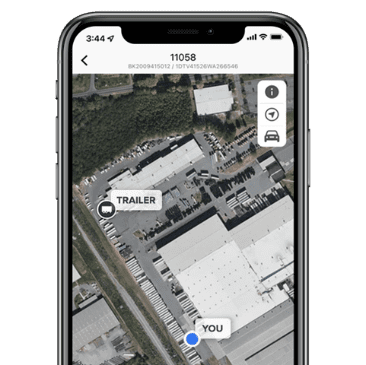
For your best chance of success, it’s important to look for a few key differentiators, paying special attention to whether the trailer telematics provider uses cutting-edge technology. A few important features to look for include intelligent reporting and analytics, improved driver experience, sophisticated cargo sensing technology, and a managed services option.
The right reporting and analytics solution not only provides you and your fleet with ample data, it also intelligently organizes and presents that data in a consolidated, customized, actionable format. You should be able to use this tool to do things like automate yard checks, manage trailer pools, obtain real-time visibility into utilization, evaluate inactivity, and get detailed history reports.
When it comes to improving your driver experience, timely information is key. One of the top contributors to truck driver burnout is the amount of time wasted waiting around. This time could be significantly reduced with the use of something like a driver information app on their phone. That way, all the information they need to make more money and be more efficient – from trailer location to navigation to load status – is right in the palm of their hand.
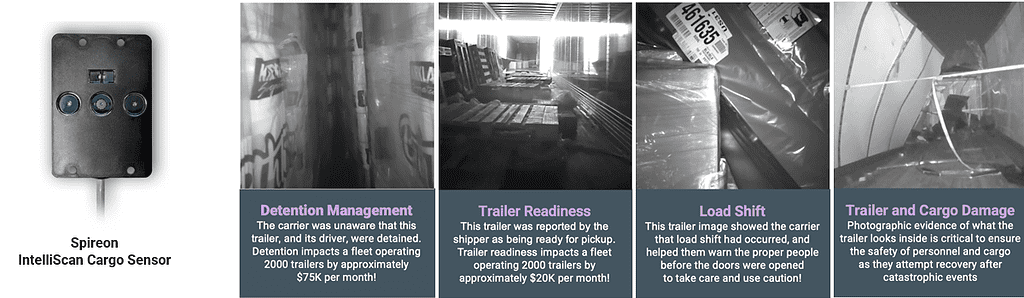
Did you know that the industry standard ultrasonic cargo sensing technology is only 70-75% accurate? Cargo information accuracy is critical to maximizing efficiency. Look for cutting-edge technology that uses a combination of features like time-of-flight lasers, optical imaging, and machine learning. This kind of comprehensive cargo visibility can not only help reduce detention time, but it can also provide critical volumetric information for optimizing your loads.
Finally, one of the best ways to backfill your employment needs is by skipping the direct-hire process altogether with a managed services option. The right managed services program goes beyond consultative trailer management by industry experts – it can also help maximize ROI on your telematics investment, provide key benchmarking information, and give meaningful, actionable insights.
As you can see, trailer tracking technology has come a long way from one location ping a day. Solera Fleet Solutions offers all these key features and more to provide you and your fleet with comprehensive, real-time trailer visibility through Spireon. If you want to hear more from Roni and Elana about how Spireon can transform your business through intelligent trailer management, you can sign up to view this webinar on-demand. For more information about trailer tracking and asset management, please contact us here or speak with your sales representative.
Our next webinar in the series takes place on October 6 and covers knowing fact versus fiction when it comes to ELDs and compliance. Register now to reserve your spot.
We hope to see you there!
The post Do more with less: Maximize resources with intelligent trailer management appeared first on Solera.
]]>The post Ultimate guide to digital marketing for car dealerships in 2022 appeared first on Solera.
]]>In this guide, we’ll explain what digital marketing is, discuss why it’s important, and provide several digital marketing strategies to help you reach more customers and boost your sales.
What is digital marketing?
Digital marketing is a multifaceted approach to promote services, goods, and brands using the internet and electronic media. It relies on various channels, such as mobile apps, websites, social media platforms, and instant messaging, to improve customer engagement.
Essentially, if a marketing campaign involves online or electronic communication, it’s digital marketing.
Why is digital marketing important for car dealerships?
There are many benefits to implementing a digital marketing strategy for your car dealership. Here are some of the advantages:
Increase online visibility
The first organic (unpaid) search result in Google Search has an average click-through rate (CTR) of about 28%. This means that if your website link is in this top spot, you are likely attracting more potential customers.
If your car dealership relies only on conventional marketing strategies, it’s time to make changes. While radio, TV, and billboards play an important role in marketing and sales, their impact has lessened in today’s environment. Consumers now spend most of their time online, so engaging with them there will boost your sales.
Personalize the experience
Digital marketing allows you to market the right products to the right customers. And tailor your actions to provide better value to your audience. For instance, when a potential car buyer visits your site, allowing them to personalize their experience will help you better meet their needs. This may be through a chatbot feature, newsletter subscription sign-up, or by publishing relevant and browsable content so viewers can find answers to their questions and solutions to their problems on their own.
Engage with customers directly
Social media is a great platform to ensure engagement with your potential buyers or target audience. Social media platforms can help you engage potential buyers and create a community where they can ask questions, voice their concerns, and be part of a conversation.
By responding to specific questions, your car dealership can be seen as a knowledgeable and trustworthy market leader. This can lead to potential customers being more likely to buy a car from you, as a bond of trust has been established—a bond that may be lacking between your competitors and potential buyers.
The fact that you can immediately and directly engage with your target audience allows for valuable feedback opportunities from prospective buyers. This allows you to continuously improve your digital marketing strategies as your target audience evolves.
5 Digital Marketing Strategies Your Car Dealership Should Consider
Here are some of the best digital marketing strategies to help you attract and retain today’s connected car buyers:
1. Email marketing
Email marketing continues to be one of the most effective digital marketing strategies. In fact, it has the highest return on investment of all kinds of marketing, averaging about $42 in return for every $1 spent.
And personalized emails convert better. Research conducted by G/O Digital revealed that about 35% of car buyers prefer emails based on their interests. Further, 28% said they would click on a car dealership email if it includes a model, color, or style they’re interested in.
With today’s sophisticated data sets, you can segment prospective customer audiences based on a wide range of selects, including their current car’s make, model, and Black Book value, those most likely “in the market” for a new car, and other demographics, such as hobbies, income, and more.
2. Social media marketing
A study conducted by the CMO council revealed that 23% of buyers talk about purchasing a new car on social media and about 38% say they’ll consult social sites prior to purchasing. So, if you’re not posting and advertising on social media platforms, like Pinterest, Instagram, Twitter, and Facebook, you’re likely missing out on opportunities.
An effective social media marketing strategy includes sharing useful, relevant, and interesting content on various social channels several times a week. It also includes engaging in conversations on your pages, posting inventory and happy customer photos, responding to reviews, and making your dealership contact details easily accessible.
3. Search engine optimization
Search engine optimization (SEO) refers to the process used to improve the viability and visibility of your website through online searches. . Implementing good SEO strategies will, in time, increase the likelihood of your website being served to people searching for car dealerships. According to Google, 95% of car buyers use digital research as a source of information. In fact, twice as many begin their search online than by visiting a dealer. So if your website isn’t performing well and isn’t one of the top displayed sites through Google or other search engines, you’re losing 95% of potential opportunities.
Perhaps the two most important tactics of a strong SEO strategy are high-quality, keyword-focused content publication and link building. While it may take time for search engines to recommend your website over others, you will no doubt improve the quality and quantity of your site traffic, thereby increasing the likelihood of your website getting discovered by people looking for a new car.
To create relevant content using the right keywords, you must understand your target audience. For example, if you want to attract potential buyers searching for California car dealerships, consider including terms like “automotive car dealers in California, “auto car dealership in California”, or “car dealerships near me” within blog posts or on your website pages. But to really improve the quality and relevancy of your content planning, use a keyword research tool to best identify and discover new industry-related keywords. Many of these tools are free and easy to use and will help you determine the right keywords, including Spyfu and WordStream.
4. Mobile optimization
Mobile devices changed how buyers research cars they want, as well as how they discover new or different vehicles. A study commissioned by Facebook revealed that 71% of consumers use their phones during the vehicle purchasing process, and about 58% said that in the future they only intend to use their smartphones for all their vehicle research.
A mobile-first and responsive dealer website is more crucial than ever. Google and other search engines rank websites on the overall page experience. This includes, among many other factors, the usability of a website on a cellphone and the page load time. Ensuring your website is optimized for mobile devices increases your SEO rankings and chances of gaining new customers.
Here are a few tips to implement yourself or pass to your web developer:
- Test your website: Consider testing your site pages on several devices to learn page loading times, whether the content is legible and accessible, how well the design and features work on smaller screens, and if the navigation is easy to use.
- Use CSS to make your site responsive: Responsive websites automatically and smoothly adjust the layout and flow of content based on the size and resolution of the device. You can use CSS to implement media query ranges, also called responsive breakpoints, so browsers load different webpage layouts depending on the device.
- Choose a responsive website theme: Because responsive sites perform better on all devices, consider installing a new responsive theme when designing a new site. To determine if a theme is responsive, access a demo before installing it. Theme demos often include previews of how pages will render on different-sized screens.
5. Video marketing
Video marketing refers to the strategic use of videos to promote and inform about services or product inventory and to boost engagement on digital and social channels.
About 66% of marketers say they’ll either increase or maintain their spending on video this year. By its very nature, video marketing better captures viewers’ attention and is often more engaging compared to other mediums, such as imagery and text. In fact, according to a study by Google, 64% of people who used YouTube while purchasing a car were influenced by it. That’s more than magazines and newspapers.
Here are a few tips on creating effective video marketing at your car dealership:
Know what your audience wants in the video
When you organize each video, consider what your audience would like to watch. For example, if you’re filming a tour of your dealership, consider asking yourself questions like, “What areas of the dealership are customers interested in?”, “What do customers want to know about our dealership?”, or “What questions do buyers have about our dealership?”. When planning each video, always keep customer needs top of mind.
Showcase more than your dealership’s inventory
While your auto inventory may be your dealership’s focus, buyers want to know more about your dealership’s values, policies, team, and how you can help them after the completed sale. Instead of only filming walk-throughs of every new vehicle, consider capturing everyday life on the lot and introducing key team members on the floor and in the service department. You’ll educate and build relationships with future customers.
Stay on brand
Is your dealership customer-centric and friendly? Or are you known for a more serious buying experience? Whatever the brand personality, make sure to highlight this when recording. Keeping a consistent brand voice allows your dealership to capitalize on its brand reputation and share it with new audiences.
Keep it short
People know no longer have the interest or attention span to watch several five-minute videos in a row. Thus, when creating video, keep it short. Videos that are up to two minutes long get the most engagement. After two minutes, there’s a significant decrease.
Accelerate your car dealership’s operations now
Understanding your buyers is the first and most important step in developing successful digital marketing strategies. Through a combination of social media, email, website, and video marketing tactics, you will improve your car dealership’s online visibility and reach a more engaged, interested audience. If you want to improve your digital marketing strategy, consider using Solera’s AutoPoint. This robust suite of solutions connects all the dots of the vehicle’s lifecycle. It offers every tool you need to promote sales, launch effective digital marketing campaigns, supply proper documentation, provide maintenance support, and improve customer retention. Reach out to us at Solera today and let us work with you to create a digital marketing strategy that will help you rise above the competition.
The post Ultimate guide to digital marketing for car dealerships in 2022 appeared first on Solera.
]]>The post Solving your service absorption problems with data appeared first on Solera.
]]>Dealerships and their service managers are constantly trying to solve the problem of their customers defecting and servicing their vehicles at aftermarket locations. OEMs pay dealerships bonuses based on the number of OEM customers registered in their primary marketing area, compared to those OEM customers who continue to service through the dealership. In general, dealers need approximately 70% of the total brand vehicles servicing with them to get their bonus.
Solving the Defection Problem
What can service managers do when service cycles are getting longer and longer, and dealerships are unaware that customers have defected until it is too late? A considerable defection period occurs when a new vehicle’s warranty expires, and the customers start to service in the aftermarket instead of returning to your dealership. When that vehicle is sold to its second or third owner, the dealership must wait until that vehicle is registered in their primary marketing area and will not know who the owner is unless they have the registration data or if that customer decides to visit the dealership for service.
So, how many of your customers are defecting to the aftermarket? If you could capitalize on these known defectors, and “in the market” for service customers, how much closer would you be to hitting your OEM’s benchmark for servicing vehicles in your primary marketing area?
Who are these Known Defectors?
Known Defectors are people who own a particular make of vehicle, and who live within a certain radius of your dealership. By using proximity targeting, dealerships can now identify when a mobile device has been to an aftermarket location. Proximity targeting uses latitude and longitude information to determine if a mobile device is at an aftermarket location and can track the length of time they are there. When a customer is at an aftermarket location for over 30 minutes, they become a “known defector.”
In addition, data partners have the ability to scrape credit card statements in aggregate to see if customers have charges on their credit cards from aftermarket locations and can even see what service was provided. Using this data, these audiences can be specifically targeted with Facebook and display advertising, which can bring them back into the dealership when it is time to service again.
How does this work exactly? Take a real-world example: Peggy recently got an oil change at Jiffy Lube. The proximity targeting data determines that her phone was at the aftermarket location, in your dealership’s primary marketing area. Also, data partners see the charge for the oil change on her credit card. Peggy then receives advertising for a special offer that brings her back into the dealership for her next service instead of going to the aftermarket location the next time she needs an oil change.
How Do You Identify a Customer Who is “In the Market” for Service?
Data can also help dealerships find people who own a particular make of vehicle, live within a certain radius of the dealership, and are “in the market for service”. When customers visit different dealership websites and aftermarket websites, or are searching online for service parts or locations, that information can be tracked. This online activity indicates that the customer is in the market and then they can be sent a Facebook or display ad as well to encourage them to visit your dealership. Now you can entice the customers with digital ads and special and special offers that can bring them into your dealership.
For example, Doug’s car just broke down and he needs a new alternator. Data informs the dealership’s marketing team that Doug owns a Toyota Camry in the dealer’s primary marketing area. Doug gets his vehicle towed and calls his friend Ryan for a ride. They go back to Ryan’s house to start researching prices and more information. They might google “prices for alternator” and start visiting aftermarket websites like Jiffy Lube, AutoZone, to price out alternators and the cost of getting one installed. This online activity moves Doug into the “In the Market for Service” audience and is shown advertising for service at the Toyota dealership in his proximity. Doug then receives exceptional service from the dealer and becomes a loyal customer of that dealership for future service and vehicle purchases.
Does This New Technology Work? It did for a Luxury OEM!
Since this technology is new to the marketplace, a luxury OEM recently ran a pilot to determine its effectiveness. The pilot ran in the OEM’s selected store’s primary marketing areas for two months. Nine total stores participated, ranging from small to larger stores targeting owners of vehicles for this luxury OEM. who were defecting or in the market for service with advertising. On average, dealerships got $18 back for every $1 spent on advertising. Small stores reported an ROI of $16 per $1 spent. Medium stores reported an ROI of $18 per $1 spent, and large stores reported an ROI of $22 per $1. After the pilot, this luxury OEM is now rolling out the technology to all their stores across the country to continue capturing these known defectors and use the data for maximum service absorption.
If your dealership is interested in learning how to capture Known Defectors, and reach customers currently in the market for service, you can learn more at solera.com/knowndefectors.
The post Solving your service absorption problems with data appeared first on Solera.
]]>The post Shop management software to grow your auto repair business appeared first on Solera.
]]>To save time and boost profits, you need software that can streamline processes, keep jobs and financial data organized, improve customer communication, and more. Here are the different types of software that can help keep your auto repair business firing on all cylinders.
Technical Auto Repair Information
Technical auto repair information can be broken down into a few basic categories:
- Vehicle servicing
- Maintenance
- Diagnostic data
- Repair procedures
Also, each category works slightly differently for different types of vehicles, including cars, motorcycles, and vans.
To manage technical repair data, you need software built explicitly for each type of information you have to manage and the different kinds of vehicles that arrive in your shop. This is especially important as drivers diversify their vehicles, often shifting towards smaller, more fuel-efficient solutions.
Just as importantly, your software has to be online. Your cloud provider’s security systems safeguard cloud-based software, and it’s also easy to access from various locations. This way, shop managers, technicians, and support staff can access the information they need to do their jobs no matter where they are, as long as they have an internet connection.
With Workshop by Autodata, for example, you get technical information from 142 original equipment manufacturers for 34,000 different models. This solution gives you access to the crucial technical data of 99% of all vehicles on the road, including:
- 360,000 wiring diagrams
- 600,000 step-by-step instructions
- Regular vehicle updates
Repair Shop Management
An auto repair shop that runs efficiently enjoys better profits and produces more satisfied customers. Some of the essential functions that repair shop management software must address include:
- Customer management
- Invoicing
- Estimating
- Reporting
When all these systems work together on a single platform, the overall management of your repair shop is centralized, organized, and streamlined.
These benefits are precisely what you get with Solera’s Direct-Shop software. Direct-Shop provides tools for estimating, managing customers, reporting, and invoicing that are easy to use and implement.
Auto Repair Shop Marketing
Even though many repair shops have regular customers that come again and again when they have issues, connecting with new—and existing—clientele helps you grow your business.
In today’s marketing environment, you need a flexible solution that incorporates several different kinds of advertising channels, including:
- Online ads
- Social media
You also must understand exactly what each customer needs to hear and see to help move them through the marketing funnel.
With Direct-Target, you get an ideal digital marketing platform. In addition to managing campaigns across social media, online ads, and email, Direct-Target also enables you to boost your strategy with geo-targeted ads and AI-powered predictive marketing. With these features, you can custom-design your marketing to reach customers precisely where they are while also giving them the most compelling messaging.
Parts Distribution Management
Parts distribution management also involves balancing multiple elements, for example:
- Product descriptions
- Images
- Specs
- Service bulletins
When you can manage all these with one software solution, it’s easier to identify and source the parts that shops need for efficient repairs that keep their customers coming back.
For example, if you have the right product descriptions, you can eliminate miscommunications regarding the parts that best address specific repair needs. For instance, while, in many cases, knowing the vehicle year, make, and model is enough to identify the correct part, other elements, such as color and build material, can be equally important.
With TurboParts, you get a centralized system that provides you with the kinds of images, descriptions, and specs that enable you to ensure your repair shop customers get the right parts every time.
Furthermore, TurboParts can serve as a unified e-commerce engine. This way, you have a single system that ensures quick, easy ordering for all of your clients.
Auto Recycling Yard Management
Recycling yards, with parts, constantly flowing in and out and vehicles that may have dozens of useful components, need a robust software solution to support profits. In addition, recycling yards have to manage multiple kinds of relationships simultaneously, including partnerships with:
- Repair shops that may have vehicles that have reached their end of life
- Used car dealers that often get trade-ins they can sell for parts
- Parts resellers that need inventory to sell to their customers
But you also need to be able to reach a vast – even global – market with your products. By diversifying your clientele this way, you create more and more opportunities to sell recycled parts.
With Hollander, you get a software solution that empowers you to:
- Manage your yard, including every aspect of your recycling business and the parts you provide
- Boost efficiency by controlling your most essential processes, which makes it easier to boost productivity while limiting the time and energy it takes to do so
- Build relationships with customers, making sure you’re able to provide them with exactly what they need at the right time and price
Auto Shop Software Solutions by Solera
Solera’s full suite of auto shop, supplier, and recycling yard software puts you in control. Solera’s solutions, give you deep visibility into every aspect of your business. You also get the ability to control the granular details that enable more significant profits and happier clients.
With the right software, it’s easier to identify ways to grow your business and inefficiencies that may be impacting your bottom line.
Learn more by connecting with Solera today.
The post Shop management software to grow your auto repair business appeared first on Solera.
]]>